

guide
The Gladstone bag: a century of colonial service
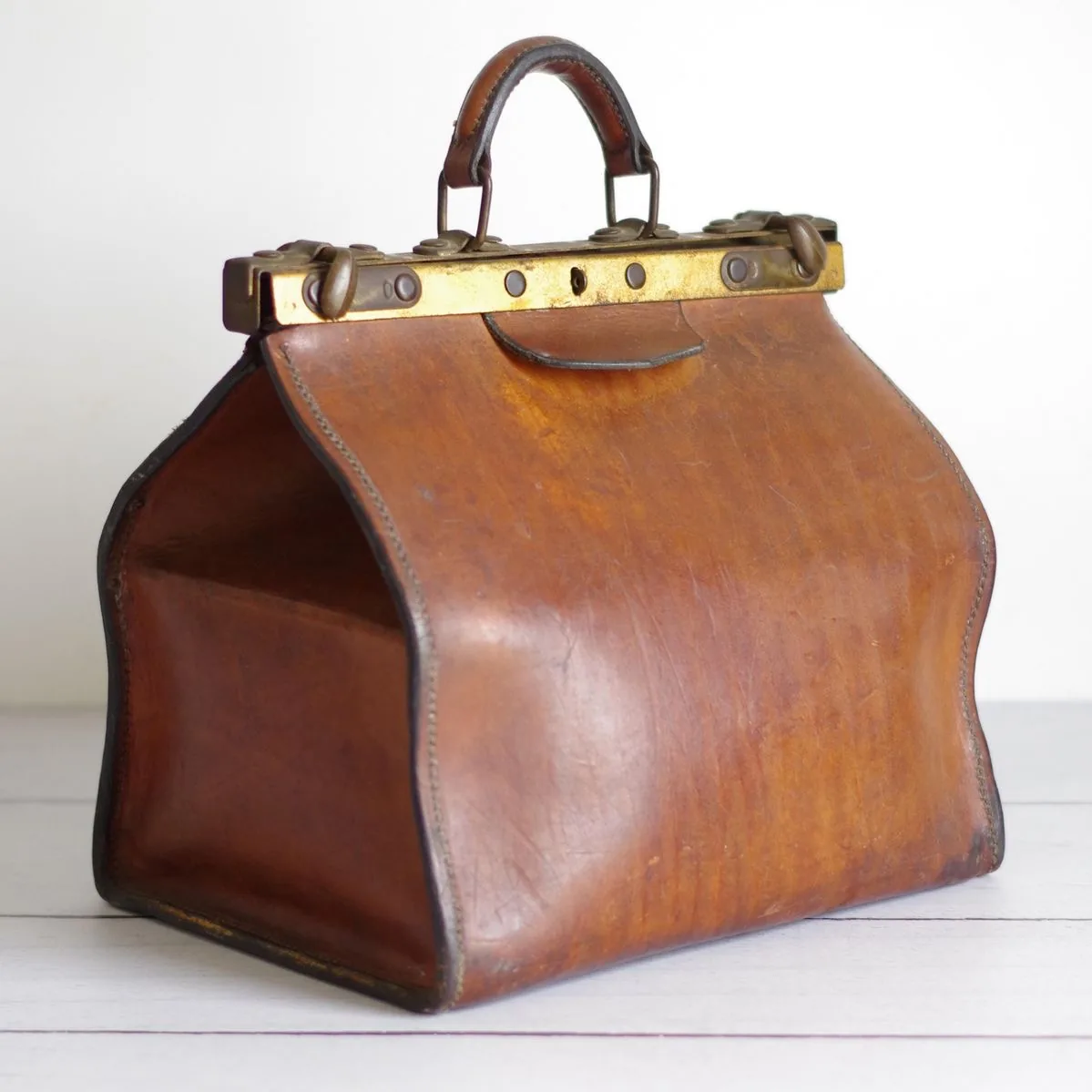
Named for Victorian prime minister William Gladstone, this hinged leather valise served British professionals across the Raj — physicians, barristers, district officers — designed to open flat and carry the instruments of administration.
The history
The Gladstone bag emerged in the 1850s, popularised by William Ewart Gladstone during his tenure as Chancellor of the Exchequer and later Prime Minister. Unlike the rigid portmanteau, its hinged frame allowed the bag to gape wide, revealing compartments for documents, surgical tools, legal briefs, or revenue ledgers. By the 1880s, it had become standard issue for Indian Civil Service officers and touring British professionals — a portable office built to withstand the Deccan heat, monsoon crossings, and inspection tours across vast districts. The best examples were commissioned from saddlers in London or Calcutta, stitched in full-grain cowhide with brass hardware that bore regimental or departmental insignia.
How to authenticate
- Hinge mechanism: Look for a rigid metal frame at the mouth that allows the bag to stand open at nearly 180 degrees; post-1920 reproductions often use soft leather gussets instead
- Maker's stamp: Genuine period pieces carry tooled marks inside the flap — 'Swaine Adeney Brigg, London' or 'William & Co., Calcutta' with a four-digit patent or catalogue number
- Stitching gauge: Hand-saddle stitching at 6-8 stitches per inch in waxed linen thread; machine stitching indicates post-Independence manufacture
- Brass fittings: Original locks and corner protectors show hand-filed detailing and a warm patina; modern replacements are die-cast and lack tool marks
- Interior lining: Suede, canvas, or moleskin in burgundy, forest green, or navy; synthetic linings date a piece to after 1950
- Provenance marks: Monograms, department stamps ('IMS' for Indian Medical Service), or faint ink annotations on inner pockets
Budgeting in INR
Entry-level Gladstone bags in restorable condition — worn leather, replaced locks, unclear provenance — begin around ₹18,000 to ₹35,000. Mid-tier examples with maker's marks, original hardware, and documented colonial service (a faint 'Bombay Presidency' stamp, a physician's brass nameplate) trade between ₹55,000 and ₹1,20,000. Museum-grade specimens — attributed to a named saddler, bearing regimental insignia, retaining all original fittings and a paper trail linking them to a known ICS officer or Viceroy's staff — can command ₹2,00,000 to ₹4,50,000 at specialist auctions. Condition of the hinge frame and legibility of interior stamps determine premium.

Care
- Store in a climate-controlled environment at 18-22°C with 45-55% relative humidity; leather desiccates in air conditioning and blooms mould in monsoon damp
- Condition twice yearly with a pH-neutral leather balsam; avoid modern conditioners with silicone, which seal pores and accelerate rot
- Keep the hinge oiled with a single drop of watch oil annually; excess attracts dust and gums the mechanism
- If displaying, position away from direct sunlight and rotate quarterly to prevent uneven fading of the hide
Continue reading